Should America Go to the Moon Again Stastistics

President John F. Kennedy speaking at Rice University on September 12, 1962
"We cull to go to the Moon", officially titled the Accost at Rice University on the Nation's Space Effort, is a September 12, 1962, speech by United States President John F. Kennedy to farther inform the public about his plan to land a man on the Moon before 1970. Kennedy gave the oral communication, largely written by presidential advisor and speechwriter Ted Sorensen, to a big crowd at Rice University Stadium in Houston, Texas.
In his speech, Kennedy characterized space as a new frontier, invoking the pioneer spirit that dominated American folklore. He infused the spoken communication with a sense of urgency and destiny, and emphasized the freedom enjoyed past Americans to choose their destiny rather than have it chosen for them. Although he called for competition with the Soviet Union, Kennedy too proposed making the Moon landing a joint project. The spoken language resonated widely and is still remembered, although at the time at that place was disquiet virtually the cost and value of the Moon-landing effort.
Kennedy'due south goal was realized posthumously, in July 1969, with the Apollo program'southward successful Apollo 11 mission.
Background [edit]
When John F. Kennedy became President of the U.s.a. in January 1961, many Americans perceived that the United states of america was losing the Space Race with the Soviet Union, which had successfully launched the first artificial satellite, Sputnik i, nearly four years earlier. The perception increased when, on April 12, 1961, Russian cosmonaut Yuri Gagarin became the get-go man in space before the U.South. could launch its start Project Mercury astronaut.[i] American prestige was further damaged by the Bay of Pigs fiasco five days after.[2] [iii]
Convinced of the political need for an achievement which would decisively demonstrate America's space superiority, Kennedy asked his vice president, Lyndon B. Johnson, in his role as chairman of the National Helmsmanship and Space Council, to identify such an achievement. He specifically asked him to investigate whether the U.s.a. could beat the Soviet Spousal relationship in putting a laboratory in space, or orbiting a man effectually the Moon, or landing a human on the Moon, and to find out what such a project would toll. Johnson consulted with officials of the National Helmsmanship and Space Administration (NASA). Its new administrator, James E. Webb, told him that in that location was no risk of beating the Russians to launching a infinite station, and it was uncertain as to whether NASA could orbit a man effectually the Moon first, so the all-time pick would be to attempt to state a man on the Moon. This would also be the about expensive pick; Webb believed it would require $22 billion to achieve it past 1970. Johnson also consulted with Wernher von Braun; military leaders, including Lieutenant Full general Bernard Schriever; and three captains of industry: Frank Stanton from CBS, Donald C. Cook from American Electrical Power, and George R. Brown from Brownish & Root.[four]
Kennedy stood before Congress on May 25, 1961, and proposed that the Usa "should commit itself to achieving the goal, before this decade is out, of landing a man on the Moon and returning him safely to the Earth."[5] Not anybody was impressed; a Gallup Poll indicated that 58 percent of Americans were opposed.[4]
Kennedy's goal gave a specific mission to NASA's Apollo program. This required the expansion of NASA'south Space Task Group into a Manned Spacecraft Eye. Houston, Texas was called every bit the site, and the Humble Oil and Refining Company donated the land during 1961, with Rice Academy as an intermediary.[half dozen] Kennedy took a two-day visit to Houston in September 1962 to view the new facility. He was escorted past Mercury Seven astronauts Scott Carpenter and John Glenn, and shown models of the Gemini and Apollo spacecraft. Kennedy also viewed Friendship 7, the Mercury spacecraft in which Glenn had fabricated America'southward first orbital flying. He took advantage of the opportunity to deliver a spoken language to pulsate up support for the nation's space effort.[7] [8] Initial drafts of the oral communication were written past Ted Sorensen, with changes by Kennedy.[9]
Oral communication delivery [edit]
On September 12, 1962, a warm and sunny day, President Kennedy delivered his spoken communication before a crowd of well-nigh 40,000 people, at Rice Academy's Rice Stadium. Many individuals in the crowd were Rice Academy students.[8] [x] The middle portion of the speech has been widely quoted and reads as follows:
We set canvas on this new bounding main because at that place is new knowledge to exist gained, and new rights to exist won, and they must exist won and used for the progress of all people. For infinite science, like nuclear science and all technology, has no censor of its ain. Whether it will get a strength for expert or ill depends on homo, and merely if the United States occupies a position of pre-eminence can we aid make up one's mind whether this new ocean will be a bounding main of peace or a new terrifying theater of war. I practice not say that we should or will go unprotected against the hostile misuse of space any more than we go unprotected against the hostile apply of land or ocean, but I practice say that space can be explored and mastered without feeding the fires of war, without repeating the mistakes that man has made in extending his writ around this globe of ours.
In that location is no strife, no prejudice, no national conflict in outer space as yet. Its hazards are hostile to us all. Its conquest deserves the best of all mankind, and its opportunity for peaceful cooperation may never come again. But why, some say, the Moon? Why choose this as our goal? And they may well ask, why climb the highest mountain? Why, 35 years ago, wing the Atlantic? Why does Rice play Texas?
We choose to go to the Moon. We choose to go to the Moon...We choose to get to the Moon in this decade and do the other things, non because they are piece of cake, just because they are hard; because that goal volition serve to organize and measure the all-time of our energies and skills, because that claiming is 1 that nosotros are willing to take, 1 nosotros are unwilling to postpone, and one we intend to win, and the others, too.[11]
—John F. Kennedy
Kennedy'southward speech communication on the nation'south space effort delivered at Rice Stadium on September 12, 1962. The portion of the speech quoted on the left begins at seven:12.
The joke referring to the Rice–Texas football rivalry was handwritten by Kennedy into the speech text,[10] and is the part of the voice communication remembered past sports fans.[12] Although the Rice–Texas rivalry was highly competitive at the time of Kennedy's oral communication, with Rice holding an 18-17-ane edge over Texas from 1930 to 1966,[13] Rice has but beaten Texas in 1965 and 1994 since Kennedy's speech.[xiv] Afterwards in the speech Kennedy besides made a joke most the heat. The jokes elicited laughter from the audience. While these side comments may have macerated the rhetorical ability of the speech, and practice not resonate outside Texas, they stand as a reminder of the part Texas played in the space race.[15]
Rhetoric [edit]
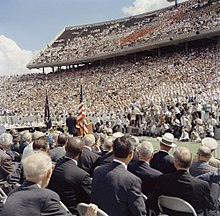
The crowd at Rice University watching Kennedy'southward speech
Kennedy's oral communication used 3 strategies: "a characterization of space as a beckoning frontier; an articulation of time that locates the endeavor inside a historical moment of urgency and plausibility; and a final, cumulative strategy that invites audience members to alive upward to their pioneering heritage by going to the Moon."[16]
When addressing the oversupply at Rice University, he equated the desire to explore space with the pioneering spirit that had dominated American folklore since the nation's foundation.[16] This allowed Kennedy to reference back to his inaugural address,[17] when he declared to the globe "Together let u.s. explore the stars". When he met with Nikita Khrushchev, First Secretary of the Communist Party of the Soviet Union and Premier of the Soviet Union in June 1961, Kennedy proposed making the Moon landing a joint project, but Khrushchev did non take up the offering.[18] At that place was rhetorical opposition in the speech to extending the militarization of space.
Kennedy verbally condensed man history to fifty years, in which "only last week did we develop penicillin and television and nuclear power, and now if America'due south new spacecraft succeeds in reaching Venus [Mariner 2], we will take literally reached the stars before midnight this night."[nineteen] [11] With this extended metaphor, Kennedy sought to imbue a sense of urgency and alter in his audience.[xx] Most prominently, the phrase "We cull to become to the Moon" in the Rice speech was repeated three times consecutively, followed by an explanation that climaxes in his announcement that the challenge of space is "one that we are willing to accept, ane we are unwilling to postpone, and one which we intend to win."[11]
Considering the line before he rhetorically asked the audience why they choose to compete in tasks that challenge them, Kennedy highlighted here the nature of the decision to go to space as being a pick, an option that the American people have elected to pursue. Rather than claim it as essential, he emphasized the benefits such an attempt could provide – uniting the nation and the competitive aspect of it. As Kennedy told Congress earlier, "whatever mankind must undertake, free men must fully share."[21] These words emphasized the freedom enjoyed by Americans to cull their destiny rather than accept information technology chosen for them. Combined with Kennedy's overall usage of rhetorical devices in the Rice University speech, they were peculiarly apt as a announcement that began the American space race.[22]
Kennedy was able to describe a romantic notion of space in the Rice University speech with which all citizens of the United States, and even the world could participate, vastly increasing the number of citizens interested in space exploration. He began by talking about space every bit the new frontier for all of flesh, instilling the dream within the audience.[23] He and so condensed human being history to evidence that within a very brief menstruation of time space travel will be possible, informing the audience that their dream is achievable. Lastly, he uses the start-personal plural "we" to represent all the people of the world that would allegedly explore space together, merely also involves the crowd.[24]
Reception [edit]

Paul Burka, the executive editor of Texas Monthly magazine, a Rice alumnus who was present in the crowd that day, recalled 50 years later that the speech "speaks to the manner Americans viewed the future in those days. It is a swell speech, one that encapsulates all of recorded history and seeks to set it in the history of our ain fourth dimension. Unlike today'due south politicians, Kennedy spoke to our best impulses equally a nation, non our worst."[ten] Ron Sass and Robert Whorl were amongst the many members of the Rice University kinesthesia present. Roll was amazed by the cost of the space exploration programme. They recalled that the ambitious goal did not seem so remarkable at the time, and that Kennedy's spoken communication was not regarded as so different from i delivered by President Dwight D. Eisenhower at Rice's Autry Court in 1960; but that speech has long since been forgotten, while Kennedy'south is still remembered.[10]
The speech did not stem a rise tide of ailment about the Moon landing attempt. There were many other things that the money could be spent on. Eisenhower declared, "To spend $40 billion to achieve the Moon is just nuts."[25] Senator Barry Goldwater argued that the civilian space program was pushing the more important military one aside. Senator William Proxmire feared that scientists would be diverted away from military machine inquiry into space exploration. A budget cut was simply narrowly averted.[26] Kennedy gave a speech to the United nations General Assembly on September 20, 1963, in which he again proposed a joint expedition to the Moon.[27] Khrushchev remained cautious near participating, and responded with a statement in October 1963 in which he declared that the Soviet Wedlock had no plans to transport cosmonauts to the Moon.[28] Yet, his military machine advisors persuaded him that the offer was a good one, equally it would enable the Soviet Union to learn American engineering science.[29] Kennedy ordered reviews of the Apollo project in Apr, August and October 1963. The concluding report was received on Nov 29, 1963, a week after Kennedy's assassination.[18]
Legacy [edit]
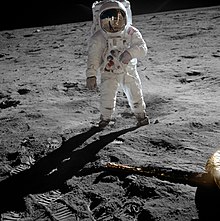
The idea of a joint Moon mission was abandoned after Kennedy's death,[29] but the Apollo Project became a memorial to him. His goal was fulfilled in July 1969, with the successful Apollo 11 Moon landing.[30] This accomplishment remains an indelible legacy of Kennedy's speech, only his borderline demanded a necessarily narrow focus, and at that place was no indication of what should exist done next once it was achieved.[one] [18] Apollo did not usher in an era of lunar exploration, and no further crewed missions were sent to the Moon later on Apollo 17 in 1972. Subsequent planned Apollo missions were canceled.[18] The Space Shuttle and International Space Station projects never captured the public imagination the way the Apollo Project did, and NASA struggled to realize its visions with inadequate resources. Ambitious visions of space exploration were proclaimed by Presidents George H. Westward. Bush in 1989, George Due west. Bush-league in 2004, and Donald J. Trump in 2017, but the future of the American space program remains uncertain.[31] [32]
Lectern [edit]
The lectern Kennedy spoke from as he gave his speech is on brandish at Space Center Houston.[33]
Notes [edit]
- ^ a b Logsdon 2011, p. 29.
- ^ Immature, Silcock & Dunn 1969, p. 109.
- ^ Hashemite kingdom of jordan 2003, p. 209.
- ^ a b Young, Silcock & Dunn 1969, pp. 109–112.
- ^ "Excerpt from the 'Special Message to the Congress on Urgent National Needs'". NASA. May 24, 2004. Retrieved May 24, 2015.
- ^ Young, Silcock & Dunn 1969, p. 162.
- ^ Hashemite kingdom of jordan 2003, p. 211.
- ^ a b Keilen, Eugene (September 19, 1962). "'Visiting Professor' Kennedy Pushes Space Age Spending" (PDF). The Rice Thresher. p. 1. Retrieved March eleven, 2018.
- ^ Malangone, Abigail (September 12, 2017). "We Choose to Go to the Moon: The 55th Ceremony of the Rice University Speech". The JFK Library Archives: An Inside Look. Archived from the original on August 25, 2021. Retrieved January 6, 2019.
- ^ a b c d Boyd, Jade (August 30, 2012). "JFK's 1962 Moon Speech However Appeals 50 Years Subsequently". Rice University. Retrieved March 20, 2018.
- ^ a b c "John F. Kennedy Moon Speech – Rice Stadium". NASA. Retrieved March 19, 2018.
- ^ Davis, Brian (September viii, 2015). "Now 53 years later, JFK asks, 'Why does Rice play Texas?'". Austin American-Statesman . Retrieved March 20, 2018.
- ^ Khan, Sam Jr. (September eleven, 2019). "'Why does Rice play Texas?': How JFK's speech communication divers a rivalry". ESPN . Retrieved Oct 13, 2019.
{{cite spider web}}: CS1 maint: url-status (link) - ^ Feigen, Jonathan (September 10, 2015). "When Rice beat Texas: October 16, 1994". Houston Chronicle . Retrieved March xx, 2018.
- ^ Hightower, Brantley (April 20, 2016). "Why Does Rice Play Texas?". Medium . Retrieved March xx, 2018.
- ^ a b Jordan 2003, p. 214.
- ^ "Inaugural Address, 20 Jan 1961". John F. Kennedy Presidential Library & Museum. Retrieved March 11, 2018.
- ^ a b c d Logsdon 2011, p. 32.
- ^ Kennedy, John. "Rice University, 12 September 1962". John F. Kennedy Presidential Library and Museum. Retrieved March 10, 2018.
- ^ Jordan 2003, pp. 217–218.
- ^ Kennedy, John. "Special Message to Congress on Urgent National Needs, May 25, 1961". John F. Kennedy Presidential Library and Museum. Retrieved March 10, 2018.
- ^ Hashemite kingdom of jordan 2003, pp. 219–220.
- ^ Hashemite kingdom of jordan 2003, pp. 220–221.
- ^ Jordan 2003, p. 224.
- ^ Young, Silcock & Dunn 1969, p. 197.
- ^ Young, Silcock & Dunn 1969, pp. 197–198.
- ^ "Address at 18th U.N. General Assembly". John F. Kennedy Presidential Library & Museum. September 20, 1963. Retrieved March eleven, 2018.
- ^ Young, Silcock & Dunn 1969, pp. 202–207.
- ^ a b Glass, Andrew (September 20, 2017). "JFK Proposes Joint Lunar Expedition with Soviets, September 20, 1963". Pol. Retrieved March 19, 2018.
- ^ Neilon, John J. (July 18, 2013). "Eastern Launch Facilities, Kennedy Space Center". Encyclopedia of Space Scientific discipline and Applied science. Hoboken, NJ, USA: John Wiley & Sons, Inc. doi:10.1002/0471263869.sst045. ISBN978-0-471-26386-9.
- ^ Logsdon 2011, p. 33.
- ^ "Text of Remarks at Signing of Trump Space Policy Directive 1 and List of Attendees". spacepolicyonline.com. May 12, 2018. Retrieved Baronial 12, 2021.
- ^ "John F. Kennedy Podium". Infinite Centre Houston. Retrieved March 13, 2020.
References [edit]
- Jordan, John W. (Summer 2003). "Kennedy'south Romantic Moon and Its Rhetorical Legacy for Space Exploration". Rhetoric and Public Affairs. 6 (2): 209–231. doi:10.1353/rap.2003.0047. ISSN 1094-8392. JSTOR 41940312. S2CID 143264606.
- Logsdon, John Chiliad. (Leap 2011). "John F. Kennedy's Space Legacy and Its Lessons for Today". Issues in Science and Engineering. 27 (3): 29–34. ISSN 0748-5492. JSTOR 43315485.
- Young, Hugo; Silcock, Bryan; Dunn, Peter Thou. (1969). Journeying to Tranquility. London: Jonathon Cape.
Farther reading [edit]
- DeGroot, Gerard (2008). The Dark Side Of The Moon: the Magnificent Madness of the American Lunar Quest. London: Vintage Books. ISBN978-i-84413-831-ix. OCLC 438328453.
- Launius, Roger D. (2011). Later Apollo: The Legacy of the American Moon Landings. New York: Oxford University Press. ISBN978-0-230-11010-half-dozen. OCLC 707157323.
- Logsdon, John M. (2011). John F. Kennedy and the Race to the Moon. Basingstoke: Palgrave Macmillan. ISBN978-0-230-11010-6. OCLC 707157323.
External links [edit]
- "John F. Kennedy Moon Spoken communication – Rice Stadium". Johnson Space Center. Retrieved March 19, 2018. Transcript and video of the speech.
- "Address at Rice Academy, Houston, Texas, 12 September 1962". John F. Kennedy Presidential Library and Museum. Retrieved March 19, 2018. Drafts of the speech, with hand-written additions by Kennedy.
Source: https://en.wikipedia.org/wiki/We_choose_to_go_to_the_Moon

Post a Comment for "Should America Go to the Moon Again Stastistics"